
Does Alipay Work in China for Foreigners? Yes — But Don’t Land With Only One Payment Plan
Alipay can work well for foreign visitors in China, but the real first-day question is what you do if card binding, verification, data, or QR payment fails.
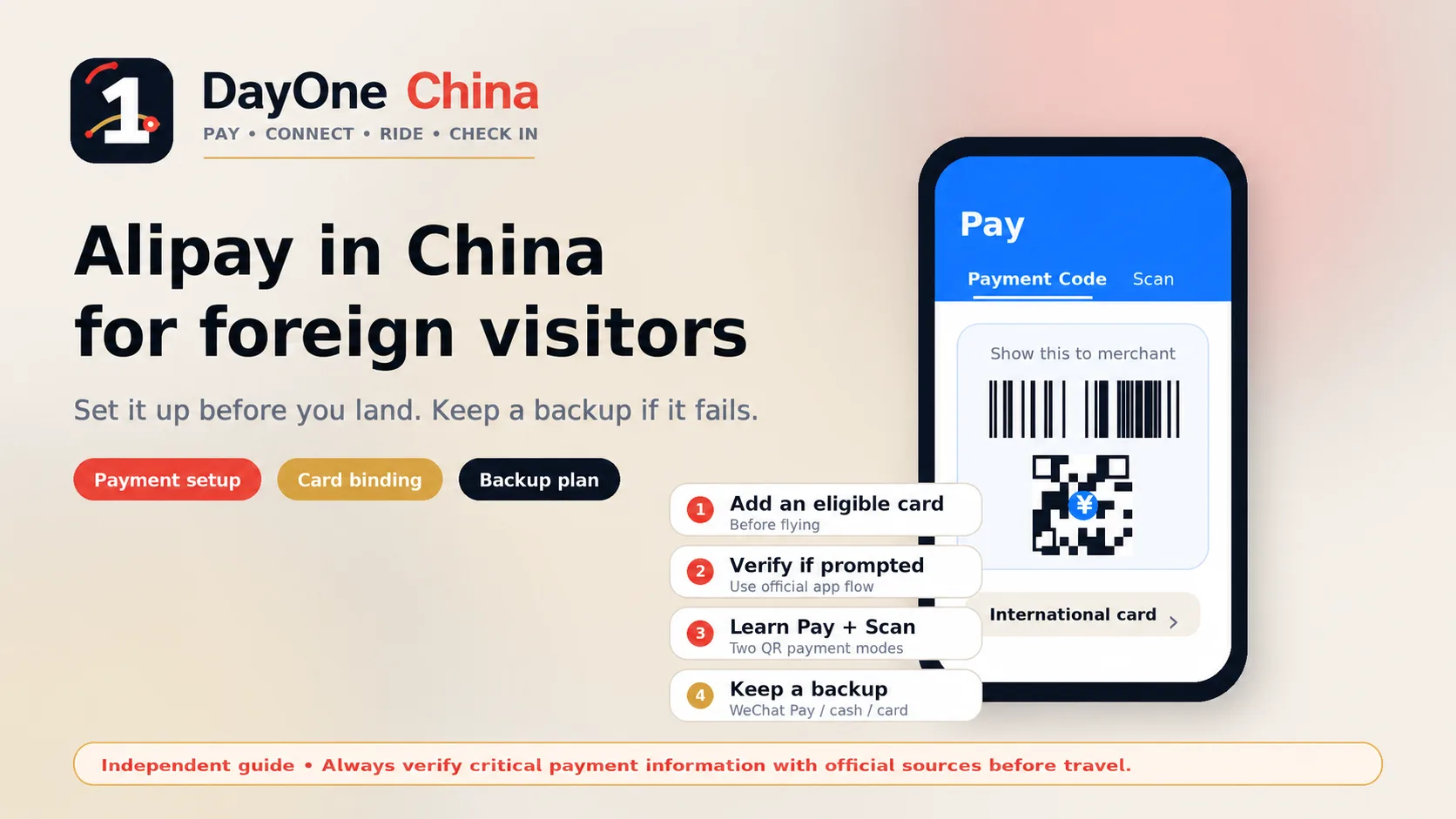
Does Alipay Work in China for Foreigners? Yes — But Don't Land With Only One Payment Plan
If you are flying to China for the first time, payment is probably the thing sitting in the back of your mind.
Not sightseeing. Not food. Not even the language.
Payment.
Can you buy water at the airport? Can you get into a taxi? Can you pay for your hotel deposit? Can you order food if the restaurant only shows a QR code on the table?
The answer is: Alipay can work very well for foreign visitors. But "I downloaded Alipay" is not the same as "I am ready to pay in China."
That difference matters most during your first 24 hours.
The simple answer
Yes, foreign visitors can use Alipay in China.
Alipay's official international traveler guidance says overseas users can download Alipay, choose the International Version after signing up, and bind eligible international bank cards. The same page describes using Alipay for daily situations such as shops, taxis, public transport, flights, hotels, and other travel services.
China's official payment guide also says overseas visitors have several payment options, including mobile payments, bank cards, and cash. It specifically notes that foreign users can link international credit cards, including Visa and Mastercard, to Alipay and WeChat Pay.
So the headline answer is yes.
The real travel answer is more careful:
Use Alipay as Plan A. Prepare a backup before you land.
Where Alipay helps most
Alipay is useful because so much of daily life in China routes through QR payment. On a normal first day, you may need it for:
- convenience stores
- coffee shops and restaurants
- taxis or ride-hailing
- metro or transport services
- hotel-related payments
- attraction bookings
- app-based services
- receipts and transaction history
The smoother your payment setup is, the less your first day feels like a test.
But the payment app is only one part of the chain. Your phone must have data. Your account must log in. Your card must bind. Your bank may need to approve the transaction. The merchant's QR code must work with your payment method. You also need to know whether you should scan the merchant's QR code or show your payment code for the merchant to scan.
That is why first-day preparation matters.
What can still go wrong
This is where many travel guides stop too early. They say "download Alipay" and move on.
That is not enough.
Here are the common first-day problems foreign visitors should prepare for.
| What happens | Why it matters | What to prepare |
|---|---|---|
| The SMS code does not arrive | You cannot finish registration or log back in when you need payment | Set up before flying and keep another payment method ready |
| Card binding fails | Your card may be eligible in theory but blocked by issuer verification, risk control, or account history | Try a second card, contact your issuing bank, and prepare WeChat Pay or cash |
| Identity verification appears | The app may ask for passport, face, or bank verification | Complete only inside the official app flow and never through random links |
| The app opens, but payment fails | Data, merchant QR mode, card issuer, or account status may interrupt the payment | Try the other QR mode, then switch to backup |
| Some screens are still in Chinese | Mini-programs, popups, or local services may not be fully translated | Use screenshot translation and keep actions simple |
| Person-to-person transfer does not work | International cards may support merchant payments but not transfers, red packets, wealth management, insurance, or similar services | Do not test readiness by trying to send money to a person |
The key point: a failed payment does not mean your whole trip is broken. It means you need a failure plan.
Set up Alipay before you fly
Do this while you are still at home, not while standing in an airport taxi queue.
- Download Alipay from the official app store.
- Register with the mobile number you will be able to access while traveling.
- Choose the International Version if it is offered.
- Add an eligible international bank card.
- Complete identity or issuer verification if prompted.
- Find the payment code screen.
- Find the scan function.
- Check that you can log back in without panic.
- Save your hotel address in Chinese before you depend on the app.
- Prepare a second payment option.
Do not enter passport, card, or SMS information through links sent by strangers. Use only the official app flow.
Learn the two payment modes
This tiny detail can save you a surprising amount of stress.
There are usually two common QR payment situations:
1. The merchant scans you. You open your payment code. The cashier scans your code.
2. You scan the merchant. You tap Scan, scan the merchant's QR code, enter the amount if needed, and confirm.
If one method does not work, the other may. If you do not know which one the merchant expects, show this simple sentence:
Should I scan your QR code, or will you scan mine? 请问我扫您的二维码,还是您扫我的付款码?
Save that phrase before you travel.
Do not call Alipay "ready" until these are true
Before boarding, check these:
- You can open Alipay on the same phone you will carry in China.
- You can reach the payment code screen.
- You can reach the scan function.
- Your card appears in the app, or you clearly understand why it does not.
- You know international-card payments may not support person-to-person transfers or red packets.
- You have another payment method ready.
- Your hotel name, phone number, and Chinese address are saved offline.
- You have enough battery and a working internet plan for the landing hour.
If you cannot check these boxes, do not rely on Alipay alone.
The first-day backup plan
Your backup does not need to be complicated. It just needs to exist.
A practical first-day payment stack looks like this:
| Layer | Use it for |
|---|---|
| Alipay | Main daily payment method if setup works |
| WeChat Pay | Backup mobile payment and communication tool |
| Second international card | Larger merchants, hotel, travel platforms, or app backup |
| Small RMB cash | Official taxi, simple meal, emergency fallback |
| Hotel front desk | Help calling a taxi, confirming an address, or solving a payment issue |
| Saved Chinese address | Essential if payment or ride-hailing fails |
Small RMB cash is not old-fashioned. It is breathing room.
What to do if Alipay fails in public
Do not stand in a queue repeatedly entering sensitive information. Do not keep trying the same failed payment ten times. Do not hand your unlocked wallet app to a stranger.
Use a short failure ladder.
First minute: Check mobile data. Reopen the app once. Do not start changing account settings in public.
Second minute: Try the other QR mode: merchant scans you, or you scan the merchant.
Third minute: Try a second card already linked in the app, if available.
Fourth minute: Switch to WeChat Pay or another ready payment method.
Fifth minute: Use cash, a larger staffed counter, the official taxi queue, or your hotel front desk.
The goal is not to prove the app works. The goal is to keep moving safely.
What about TourCard or Tour Pass?
Some travelers may see TourCard or Tour Pass / Bank of Shanghai prepaid-card options inside Alipay.
Treat this as an optional backup, not your main path.
For most first-time visitors, the first method to try is still direct international-card binding inside Alipay's official flow. A prepaid-card route may add extra identity verification, top-up rules, fees, limits, expiry, exchange-rate risk, and refund rules.
Only consider it if:
- it is visible inside the official Alipay app or official provider page
- you understand the current rules shown on the page
- you are comfortable providing the required information
- you top up only a small amount first
- you still keep other payment methods ready
Do not search random websites or scan random QR codes for "Tour Pass" setup.
A calm payment plan for your first 24 hours
Here is a simple way to think about it:
Before flying, set up payment. Before leaving the airport, confirm data works. Before getting into a car, confirm your destination. Before going out for the evening, test payment somewhere low-risk, like a convenience store. Before relying on one app, prepare a backup.
China is not hard because payment is impossible. It is hard because the first failure can happen when you are tired, jet-lagged, holding luggage, and trying not to block a line.
That is the moment you do not want to be researching app settings.
DayOne China note
Most guides tell you to download Alipay.
DayOne China tells you what to do before you land, what to check before you trust it, and what to do when it fails.
The free checklist gives you the basic pre-trip reminders. The full DayOne China First 24 Hours Setup Kit includes step-by-step payment setup, Alipay and WeChat Pay backup flows, TourCard notes, payment failure tables, Chinese phrase cards, airport-to-hotel guidance, official-source links, and offline backup cards.
Prepare payment before the flight. Prepare backup before the first failure.
Independent guide disclaimer
DayOne China is an independent travel-prep guide. It is not affiliated with the Chinese government, Alipay, WeChat Pay, payment platforms, banks, airports, airlines, hotels, telecom operators, railway companies, transport companies, or app providers. Payment app interfaces, card support, verification rules, fees, limits, official links, and transport procedures can change. Always verify critical information with official sources, your payment provider, your issuing bank, your hotel, your airline, and relevant authorities before travel.
Official sources & references
- Alipay+ — Pay in the Chinese mainlandofficialhttps://www.alipayplus.com/pay-in-the-chinese-mainland/
- State Council — Payment service guide for overseas visitors to Chinaofficialhttps://english.www.gov.cn/news/202404/11/content_WS6617c858c6d0868f4e8e5f4d.html
- DayOne China First 24 Hours Setup Kit 2026 — Payment section and payment failure playbookreference/full-kit
Related articles
DayOne China is an independent travel-prep guide. It is not affiliated with the Chinese government, payment platforms, transport companies, airports, hotels, telecom operators, railway companies, or app providers. Always verify critical information with official sources before travel.